Wednesday, March 29, 2017


Emmanuel's Stained Glass Windows Part 4

In the late 1940's it was decided that there would be stained glass windows in the new sanctuary.
I'm sure that somewhere in the archives of the history of Emmanuel there is a record of the naming of a committee – after all Baptists are known for forming committees for about any occasion. I'm sure that the chairman was probably a Bolton, (but again I speculate). I picture them gathered all together on the first floor of our three story educational building, which we call Weems Hall, formerly the Fellowship hall, as they thought deeply about the new sanctuary that was to be built and how they wanted it to be glorious for the community as well as a tribute to God. I'm sure there was discussion as to whether they should have a fund raising campaign or if individual members would cover the cost of such windows. Well, the windows were eventually purchased by the church with plans for individual members to purchase all or part of them as memorials, as best as I can understand. A plaque was to be placed under each window to indicate who purchased and to whom the memorial was for. As the discussion became more verbal, I'm sure they formed another committee to decide the design of the plaques. Since Jacoby Glass Company would not allow us to place a plaque under each window until all the windows were completed and installed and since it was unclear as to what windows would be purchased and when, the committee decided that the plaques would be at the back of the sanctuary.

Our beautiful Gothic Sanctuary was to have twenty windows total. 
 An example of one of the upper windows.
 Jesus triumphal entry on Palm Sunday.

                                                           
After discussions with Jacoby and the committee the designs were agreed upon and work began in St. Louis, Mo.  The lower section would consist of Jesus' life from the announcement of his birth until he ascended to heaven, while the upper windows would depict the parables.

However, there was a fly in the soup. 

Somewhere the ladies of the Women's Missionary Union noted that the building would be missing a window on the West side, opposite the bell tower. There were ten windows plus the bell tower on the East side but the ten windows on the West side had a blank spot toward the front of the sanctuary on the Jackson Street side, upper level. There needed to be an extra window to balance the space with the bell tower. I can imagine the discussion that went over that little flaw. And, I can imagine that there was much discussion. into the night. during a business meeting. Well, as anyone knows, you do not cross the WMU ladies when they have a bee in their bonnet. 
They immediately began raising money to purchase one more window. Which they did and helped plan. This window, although similar in design to the other on the upper level still had it's own individual features. 


  I'm highlighting this window because it is of special interest to our congregation because it is personal to our church.
 So, although this is out of order, I want to talk about the wonderful WMU window that nobody really gets to see. It is located above the stairs, leading to the balcony, on the West side. 

Symbols of note: 
Top left: Young Women's Auxillary
Center top left:  Sunbeams
Center top right:  Girl's Auxillary 
Top right:  Royal Ambassadors
Lower left:  Women's Missionary Union S.B.C. 1888
 I'm sorry that I can't show a clearer picture of these symbols.
The Great Commission. Matthew 28:16-20

Now the eleven disciples went to Galilee, to the mountain to which Jesus had directed them. And when they saw him they worshiped him, but some doubted. And Jesus came and said to them, “All authority in heaven and on earth has been given to me. Go therefore and make disciples of all nations, baptizing them in the name of the Father and of the Son and of the Holy Spirit, teaching them to observe all that I have commanded you. And behold, I am with you always, to the end of the age.”
The plaque says: “In tribute to the faithful service of the women and young people of Emmanuel Baptist Church. Women's Missionary Union”.
The basic design is the same as in the other upper windows. But instead of the red trio of stylized flowers above the two panels and the trefoil at the top, we have the symbols of the Young Women's Auxiliary, The Sunbeams, The Girl's Axillary, and the Royal Ambassadors.


 I can imagine, also, that the deacons in the late 1940's were not too pleased that the WMU was standing up for what they believed, and I'm sure they would have opposed such a move except for the fact that their women, probably, threatened going on strike at home by withholding meals or whatever. Today, we should be proud of the WMU for standing their ground, because this is a great window and the sanctuary windows look balanced when viewed from the exterior.

These ladies were leading the way for Missions in our church and even through the years, Emmanuel has always reached out to Missions.


The windows on the upper level on the East side are:

Jesus calling his disciples, "Come, I will make you fishers of men."  Matthew 4:19


(cropped right side of the window)


Jesus and the Samaritan woman at the well. "I will give you living water." John 4 
(cropped left side of the window)
Parable of the sower of seeds.  Luke 8:4-15
(complete window)
Jesus healing the blind man.  John 9
(cropped left side of window)

Jesus calming the sea.  Mark 4: 35-41 
(complete window)
The windows on the Upper level on the West side are:
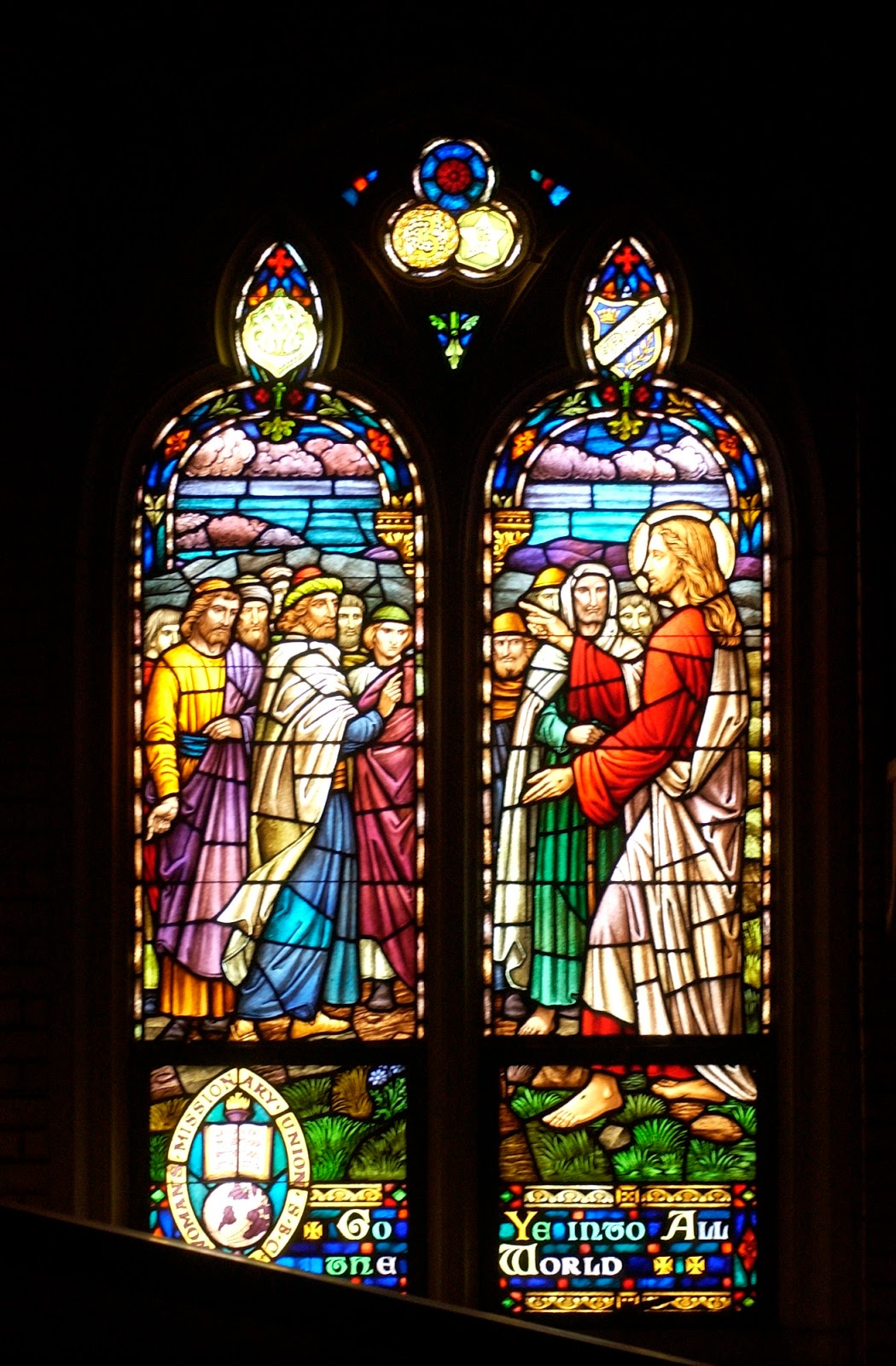
The great commission.  Carrying the message of salvation to all nations.  Matthew 28:!6-20
(complete window)
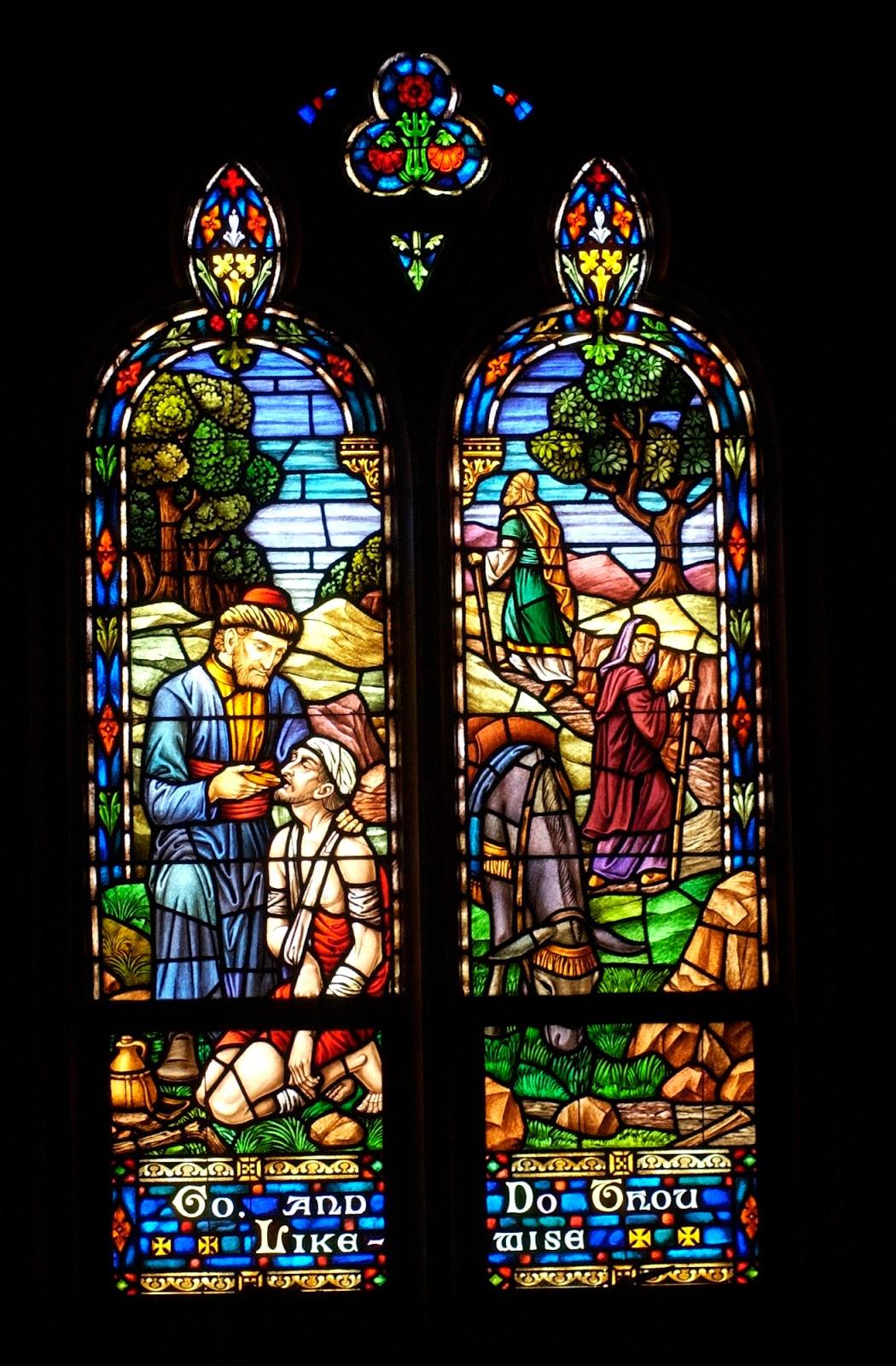
Parable of the good Samaritan.  "Love your neighbor as yourself. Luke 10:25-37
(complete window)
Jesus at Bethany with Mary and Martha.  Luke 10:38-42
(sorry, but I did not have a picture)
"Let the little children come unto me for theirs is the kingdom of heaven." Matthew 19:14
(cropped left side of window)
Widow's Mite.  Luke 21:1-4
(sorry, but I did not have a picture)
Jesus' triumphal entry on Palm Sunday.  Matthew 21:1-17
(cropped left side of window)

Thank you for allowing me to post about the Stained glass windows at Emmanuel Baptist Church, Alexandria, Louisiana. I hope it was informative and that you got to see and enjoy the beauty I see every Sunday morning.  


© Nippy Blair 2015. Posts and pictures on this blog cannot be copied, downloaded, printed, or used without the permission of the blog owner, Nippy Blair.

Tuesday, March 21, 2017


PART 3
Stained Glass windows

Emmanuel Baptist Church
1881-2017

Anytime we enter our Sanctuary, with its magnificent stained glass windows, a sermon is already in progress. The very name of our church proclaims our message: Emmanuel, God with us.


A brief history:  Emmanuel Baptist church has been in Alexandria, Louisiana for 136 years.  On September 6, 1881, 12 Charter members formed the first Southern Baptist Church in this area.  Our original name was the Alexandria-Pineville Baptist Church and we were located on Second Street in Pineville.  In 1893, after a series of revival meetings in the court house in Alexandria, they convened in business meeting and changed the name from Alexandria-Pineville Baptist Church to Emmanuel Baptist. They also purchased the property on 4th and Jackson in Alexandria, thanks to G.W. Bolton, a  founding member.

In 1896-97, the church with its 140 members moved to a new building in Alexandria on the corner of Jackson and Fourth.

In 1916,the Sanctuary burned.  The congregation met in Rapides Opera House for services (this would be the  late Paramount Theater to those that remember it)

In 1918, the Educational/Sanctuary was completed and dedicated.  This is the current three story educational building that we are in the process of renovating.
  The Sanctuary was on the 2nd floor with a 3 sided balcony. I remember looking up above the balcony and seeing the beautiful yellow glass transom windows above the third floor.  The baptistery was on the first and the members would walk down stairs when people were being baptised.

The present Sanctuary building, with these magnificant stained glass windows, was completed and dedicated on September 10, 1950. I was seven years old.    Dr. Franklin Seglar was the pastor. Dr. G. Kernie Keagan and Dr. Carl A. DeVane, former pastors participated in the service.

If you read my first two blogs on these windows then you learned of the history of stained glass in my first blog.  In the second one we also discovered that  in Gothic cathedrals, stained glass was correctly called the “Bible of the Poor”. Many of the poor were unable to read so the colors, pictures, symbols and lines had meaning and taught them the scripture.  I also gave a list of symbols to look for.  Hopefully, you may remember some of these colors and symbols that are found in our windows.  

Today, I want to look at the other lower level windows, on the West.

These are considered the Easter windows
Let's look at the first window away from the altar

"I am the Good shepherd and I know my sheep.”
  Visible symbols of note:
 snow bells (top left): new beginnings and hope 
sheaves of wheat (upper left): communion 
The Holy Bible is at the center of this window.  It is a symbol of Christian faith.
 gourd (top right): symbolizes the resurrection
 grape cluster (upper right): the blood of Christ as in the Eucharist.

 The second window from the altar

 "Nevertheless not my will, but thine, be done."
 
Jesus praying at Gethsemane that this 'cup' be removed, “Not my will but thine be done.” (note cup in God's hands.  This is another great example where the use of silver stain was used).  Here,it is a symbol of death.
Visible symbols of note:  
  cluster of three flowers  (top left): Trinity 
 cup and plate (upper left) : lord's supper
lily (top right): purity
 cross (upper right): God's suffering
The Holy Bible is at the center of this window.  It is a symbol of Christian faith.
 flowers (beneath Jesus): peace, purity

 The third window from the altar
"Father, into thy hands I commend my spirit"
Crucifixion of Jesus
Visible symbols of note:
 white flower,I think it is an iris. (top left) : Mary's sorrow at Christ's passion.
 triptych with 6 pointed star in center (upper left): the Star of David.  6 pointed star, the star of Creation. The 6 points stand for the six days of creation. It also represents the 6 attributes of God: power, wisdom, majesty, love, mercy and justice. Some refer to it as the Jewish star.
 oak leaf (top right): Jesus' cross was said to be made from oak. Victory over death. 
broken chain (upper right): Symbolizes Christ's hand reaching from heaven breaking the chains of death.
There is no Bible in the center of this window, instead there is a banner  with INRI Jesus of Nazareth, King of the Jews. 

 The fourth window
"He is not here: for he has risen."

Burial tomb with stone rolled away, “He is not here, He is risen.”  
Visible symbols of note: 
5 point white flower (top left): symbol associated with Christianity. Also purity.
The Holy Bible is at the center of this window.  It is a symbol of Christian faith.
pomegranate with seeds showing (upper left): The fullness of Christ's suffering. The resurrection of hope and eternal life. The many seeds represent the many believers in Christ (the church). It also symbolizes resurrection and power over death. 
single white flower (top right): purity and innocence
 crown with palm branches (upper right): The martyrs victory in passing through torments to the blessed life in heaven.

 The final window closest to the altar
"He was parted from them and carried up into heaven." 

Jesus ascension into heaven after blessing His disciples near Bethany.  
Visible symbols of note: 
white rose (top left): innocence and spiritual love 
alpha (upper left): beginning 
single palm branch (top right): victory
omega (upper right): end
I am the beginning and the end.
This window is also one without a Bible at the center of the scene.  On the Advent windows we have this symbol on all five windows.  On the Easter windows there are only three.

I hope you are getting some insight into these historically significant windows from the Jacoby glass company.  I do not have decent pictures of our upper windows, yet,  but hope to do so.  We still have these to discuss and the Rose and baptistry window.  In particular, I would like to share the WMU window on the upper level, west, that no one ever sees, since it was an add on for symmetry. I will be able to have a clear picture of that window.
Till next time.


© Nippy Blair 2015. Posts and pictures on this blog cannot be copied, downloaded, printed, or used without the permission of the blog owner, Nippy Blair.
 

Saturday, March 18, 2017


Emmanuel's Stained Glass Windows Part II


During the Gothic period (1100-1500) stained glass was the foremost form of painting in Europe. If you look closely at our stained glass windows you will notice that the surfaces of each piece of glass are painted in a wide range of dark tones.The term “stained glass” came about because of the use of silver stain being applied to the side that faced the outside of a building. Remember, silver stain was a combination of chemicals that were blended together and applied to clear glass. It enabled a more flexible approach to glass painting, allowing, for example, the hair of a figure to be painted on the same piece of glass as the head. It was also used to highlight details.

In Gothic cathedrals, stained glass was correctly called the “Bible of the Poor”. Many of the poor were unable to read so the colors, pictures, symbols and lines had meaning and taught them the scripture.
Some of the color symbols, and their meanings, you will find in our windows are:
Red: Chaity, Blood of Christ, A reminder of the suffering and sacrifice of the Son of Man. Our windows seem to have Jesus always dressed in red or red on him somewhere.
Blue: Hope, sincerity, love and piety. This is the color assigned to the Virgin Mary.
Green: Faith, immortality, spring. Triump of life over death
Violet: Love, truth, passion and suffering.
White/Gold: Chastity, innocence of soul and purity. The color of God.
Black: Death and regeneration.
Yellow: Power and glory, the Gates of heaven
Purple: Royalty, God the Father.
Gray: The emblem for Christ risen. Also, mourning, humility

There are also other symbols used in religious stained glass windows. You will find many if these symbols as well, on our windows, such as:
Triangle: Trinity.
Bells: news bearers, to announce Jesus conquering death, birth, etc.
Lilies: Chasity, innocence and purity. Symbol of Christ.
Lamp: the manifest presence of God as the light of the world
Harp: represents all music that is sung or played to the glory of God.
Lyre: represents all music that is sung or played to the glory of God.
Holy Bible: Christian Faith
Star of David: 6 pointed star: the star of Creation. The 6 points stand for the six days of creation. It also represents the 6 attributes of God: power, wisdom, majesty, love, mercy and justice. It is also called a Six sided star also the Jewish star.
Bright lantern: Christ's passion, word of God
Cup in God's hand: death
Broken chains: represents Christ's hand reaching from heaven and breaking the chains of death.
Five pointed star: symbol associated with Christianity.
Pomegranate: The fullness of Christ's suffering. The resurrection of hope and eternal life. The many seeds represent the many believers in Christ (the church). It also symbolizes ressurection.
Wheat: Can represent Believers, the Body of Christ, the bread in the communion.
Dove: Holy Spirit with an olive branch...the end of God's judgement and the beginning of a new covenant with man.
Clover: trinity
Oil Lamp: Holy Spirit
Lotus flower: purity
Anchor:the hope of having Christ beyond this life.
Chalice with grapes: the Eucharist. Jesus as the true vine.
Daisy: innocence of the Holy Child.
The vine, grapes, sheaves of wheat: elements of communion
Fruit: A symbol of the 12 fruits of the spirit.

On the lower level of our sanctuary the windows tell the story of Jesus' life, death and resurection.
The windows on the East side are considered the Advent windows. They deal with the announcement of Jesus' birth through his baptism by John the Baptist.  Look for continuity in all these windows.

Let's look at the first window from the altar: 
"Fear not for behold, I bring you good tidings of great joy"


This is the angel's announcement to the shepherds of the birth of the savior, "Who is Christ the Lord?"
note:  The Holy Bible is at the center of this window (above the six-sided star) and is in all but two of the other windows.  It is a symbol of Christian faith.) 
Visible symbols of note:  
handbells (upper left): news bearers, to announce Jesus conquering death, birth.
 Dove (upper right):  Holy Spirit.
Triangle (upper right):  Trinity
 Pomegranate (open flower shape on the top left): The fullness of Christ's suffering. The resurrection of hope and eternal life. The many seeds represent the many believers in Christ (the church). It also symbolizes resurrection.
Wheat  (top right) :  bread of life.  Holy communion.
The lamb between the shepherds and the angel:  the lamb of God.
Notice that the six-sided star is in the center of this window.  It is a Jewish symbol representing the six days of creation.
Continue looking for symbols from the list above like bells, lilies, harps, stars, triangles, as well as color symbols.

The second window from the altar

"And they came with haste and found Mary and Joseph, and the babe, lying in a manger."
Notice the bright light of the lantern.  This is a prime example where silver stain was used.   The manifest presence of God as the light of the world.
Visible symbols of note:
 Clover (top left): trinity
Oil lamp (upper left)  :  represents the word of God.
Lotus flower (top right):  purity
Anchor (upper right): Christian's hope in Christ.
The Holy Bible is at the center of this window (above the six-sided star) and is in all but two of the other windows.  It is a symbol of Christian faith.)
Here the six sided Jewish star is on the left
Continue looking for symbols from the list above like bells, lilies, harps, stars, triangles, as well as color symbols.

The third window from the altar
"We have seen his star, and are come to worship him."
Wise men bearing gifts see the Star in the East and come to worship Jesus.  
Visible symbols of note:
sunflower (top left): worship and faithfulness.  
 Musical instruments:  Music in worship (we are a singing faith).
 Sheave of wheat:   believers, body of Christ. Bread of life.
 harp: worship 
The Holy Bible is at the center of this window (above the six-sided star) and is in all but two of the other windows.  It is a symbol of Christian faith.)
Here the six sided Jewish star is on the right. 
  Continue looking for symbols from the list above like bells, lilies, harps, stars, triangles, as well as color symbols.
The fourth window from the altar.
    "And all that heard him were astonished at his understanding and answers.
Jesus at the age of 12 standing in the Temple amazing the priests with his knowledge. 
Visible symbols of note:
3 white flowers (top left): innocence of the holy child 
10 commandments (upper left): the law of God for spiritual and moral living 
The Holy Bible is at the center of this window (above the six-sided star) and is in all but two of the other windows.  It is a symbol of Christian faith.)
Holy Bible (upper right): the word of God
 Flowers (top  right): innocence of the holy child 
  Continue looking for symbols from the list above like bells, lilies, harps, stars, triangles, as well as color symbols.

The fifth window from the altar (near the bell tower) 
    "Jesus came and was baptized of John in Jordan."
This is probably my favorite window. Maybe because no matter what time of the year, this window always captures the sunlight at seven in the morning.  The colors are absolutely remarkable.
Baptism of Jesus by John the Baptist with the voice of God, “This is my beloved son with whom I am well pleased.”


Visible symbols of note: 
descending dove (upper left): Holy Spirit
white flowers (top left):  innocence and peace, purity
grapes (top right):  communion
lying lamb with flag (upper right):  lamb of God

The Holy Bible is at the center of this window (above the six-sided star) and is in all but two of the other windows.  It is a symbol of Christian faith.) 
black bird:  considered a good omen.
cat tails:  A  lowly common plant.  Symbol of the multitude of the faithful who live a simple life and obey the teaching of the church.  The source of living water.
 Continue looking for symbols from the list above like bells, lilies, harps, stars, triangles, as well as color symbols.
     
© Nippy Blair 2015. Posts and pictures on this blog cannot be copied, downloaded, printed, or used without the permission of the blog owner, Nippy Blair.
     

Monday, March 6, 2017


Stained Glass Windows

Emmanuel Baptist Church


Today, I want to talk about the stained glass windows in my church, Emmanuel Baptist, in Alexandria, Louisiana.  These windows were placed in our current sanctuary in 1949-1950.  I was seven years old and have always been fascinated with these windows.  I do believe my artistic senses were greatly influenced by seeing them week after week.  Even today, when I open the building on Sunday morings, I pause to reflect and admire their beauty. It is a religious experience, at it's best, to sit in an empty sanctuary at seven in the morning on a sunny day, lights off, and witness the sun streaming through the glass sending awe-inspiring light into the room.  

Today I will focus on the technical aspects of the windows.  Another blog will share individual windows, color and religious symbols.

The windows in this sanctuary are traditional leaded stained glass windows. And were crafted by the Jacoby Stained Glass Studio in St. Louis, Missouri.

These windows were installed when this sanctuary was built. Our windows are placed in chronological order from birth to resurrection. (note: during the Heart of Spain tours of our windows, we met some people from Belgium who had visited many countries and church windows and said these were the first they ever saw that were in chronological order)

The windows were purchased by individual members.  Originally, a plaque was to be placed under each window to indicate who purchased and to whom the windows were in memory of.  Jacoby Glass Company would not allow us to place a plaque under each window until all the windows were completed and installed.  Our compromise was to place the plaques at the back of the sanctuary.

Our windows were designed and cartooned by James Blackford, a master craftsman who came from England to work with Jacoby . They were painted by Tom Dixon who also came with Blackford from England.

The Jacoby web page indicates that there are some noted Blackford Stained Glass windows in America.  Ours is one.
They are: 
St. John's Episcopal in Ft. Worth, Texas,
Emmanuel Baptist, Alexandria and
St. James Episcopal in Wichita, Kansas.

JACOBY STAINED GLASS, ST. LOUIS, MO. is signed on the lower right side of the Baptistery window.

All of these windows were fabricated using handmade, mouth blown antique glass (antique class was required to be 100 years old) and painted in the traditional Trace and Matte technique of glass painting:  Using the drawing as a template, the glass is selected and cut, and each piece of glass is individually painted using glass paint. The paint is then fired, heating the glass to approximately 650 degrees centigrade in a furnace. When all of the glass has been painted it is assembled into panels by bending 'H' section strips of lead around the pieces of glass and soldering the strips together where they meet.

The style of these windows is a mixture. The figurines and robes are in the Munich style and the borders, background, symbols and the quotes are a modernized version of the Gothic Revival style.
Note: Most Munich school windows have a very distinct characteristic. The figures are highly realistic, painted in a German Baroque style.

Gothic Revival Style was one of the most influential styles in the 19th century. Designs were based on forms and patterns of the Middle Ages.

Some of the antique glass is “flashed” which means that the base glass color (usually clear) is fused to another thin layer of color. This enables the glass artist to sandblast or acid-etch one of the layers to create special color shading and effects in a single piece of glass.

 There is some use of silver stain.
Silver stain is a combination of chemicals blended with pipe clay and applied to clear glass. (usually silver nitrate or silver sulphide) Pipe clay is a fine white clay .
Producing a strong clear yellow was difficult in early stained glass because it relied upon the careful control of heated furnace. The introduction of silver stain in the early 14th century provided a solution to this difficulty, and also allowed greater flexibility in the way in which colour could be used. It enabled a more flexible approach to glass painting, allowing, for example, the hair of a figure to be painted on the same piece of glass as the head. It was also used to highlight details.


The majority of the glass that is used in the windows from the Jacoby Art Glass Co. is antique glass made in the traditional pot metal method.

(When the glasses are in a molten state in a metal pot, chemicals are introduced to create the different colors. Then a gather (a soft blob of glass) is attached to the end of a blowpipe. A glassblower blows the glass into the shape of a large cylinder about 30 inches long. The cylinder is detached from the pipe, the top and bottom removed, and scored along the side. The glass is then put into an oven where, as it is heated it uncurls, and becomes a flat sheet about 30 inches by 30 inches.

Because of the way it is made, by hand and by utilizing mouth-blowing techniques, there are faults (streaks, bubbles and striations) in the glasses. Also the glass is not of uniform thickness throughout the entire sheet. The streaks, bubbles and striations break up the light as it passes through the glass creating vibrant highlights that make the glass seem to sparkle. The varying thickness makes certain areas of the glass seem deeper and richer in their coloring.

Because each sheet of glass is somewhat unique, the antique glass allows the glass artist a very large pallet with which to work. He can use the glass as it is, or he can paint the glass with glass paint. With acid or sandblasting, he can etch the glass to create more than one color in an individual glass. He can stain the glass or he can plate the glass (superimposing one or more glasses over a base glass to create a special color or visual effect).
© Nippy Blair 2015. Posts and pictures on this blog cannot be copied, downloaded, printed, or used without the permission of the blog owner, Nippy Blair.

Friday, September 30, 2016


 PURPLE CLOVERS AND CORN BOILS

Back around the beginning of the 1960's, Daddy decided that the farm on Jackson Street was getting too crowded and bought one hundred something acres out on highway 71 near LSU-A. We moved the animals there and commuted from our house on Jackson Street to the farm daily. By 1963, the year I went off to college, the family moved. I love telling people that when I went off to college my family moved from the place where I grew up and left no forwarding address. Thankfully they really did let me know. This farm is where all the Shetland pony business took place and where I spent summers painting fences. The house was originally close to the highway but was later torn down.   They moved to a house further down the pasture lane that we once rented to a professor at the college. The shed for the cars was kept, however, and became The Old Gray Mule vegetable stand. Lots of traffic began to pass. Daddy held fort in this shed, chewing his tobacco, wearing old worn out jeans and tobacco stained shirts. He played the part of the sharecropper's son well when he wasn't in Baton Rouge. At the front of the vegetable stand Daddy kept a jar, with a sign, saying, “Get what you want and put your money in the jar” for people to pay in case he wasn't there when they came to shop. Politicians stopped by on their way back and forth to Baton Rouge. (This was before the Interstate 49 was built.) That vegetable stand became a place to kick back, sit on a hay bale, visit and talk politics. I remember on several occasions Daddy might be further back on the farm on his tractor and people would stop by to see “the senator” for help. If he wasn't at the stand, then they stopped by the house. Mama would just smile and tell them to head back down the pasture lane and they would find him. I watched as they would slow down when they got near the area, look around and not seeing “the man” would walk out to the tractor and ask the hired hand plowing, “I'm looking for senator Blair,” they would say and Daddy, if he didn't want to be bothered would reply, tobacco streaming down his chin, “No, sir, I ain't seen the senator today,” and keep plowing. I always thought this so funny. They never recognized him. I'm sure they were expecting some plantation owner type supervising the hired help in a nice truck or something. We always got a good laugh out of that.

So Daddy grew sweet corn and started a menagerie of animals like white tail dear, geese, goats, a donkey and a Llama.  The donkey was gray and Daddy claimed that was the inspiration behind the old gray mule name. But we all knew different. The corn was delicious. We ate more than our share all summer long. People came from miles around for this sweet corn. 

At the end of the season, Daddy held his famous corn boils. 
  
All his friends were invited. 
  Preachers, priests, rabbis, politicians,farm hands, church members and raconteurs like Daddy all mingled under the stars sitting on hay bales enjoying lively conversation, fresh boiled corn, brisket and whatever was brought.
Dr. Larry Taylor, Bishop Greco and Rabbi Hinchin at a Corn Boil

 It was a regular pot luck dinner. Laughter was everywhere. Children were playing in the nearby barn on the hay bales, sometimes a Shetland pony was hitched to a wagon for the kids to enjoy. Men gathered in a corner talking politics and women bustled over the plates of food making sure everyone was fed.

 If the crowd got too rowdy, or too much drink was consumed, Mama sent them home.

During this time, Lyndon B. Johnson was President of the United States from 1963 to 1969. Lady Bird began her highway beautification project not long after they moved in. At first millions of flowers were planted in and around Washington, D.C. for the enjoyment of tourists and residents. In October of 1965 the Highway Beautification Act was signed by the President. It was nicknamed the Lady Bird bill. Several states began some highway beautification programs. My daddy took notice. He was in the state senate from 1960-1964 and again from 1966-1976. He never pursued any legislation, that I am aware of, concerning highway beautification, but he paid attention to what Lady Bird was doing.

In 1975 Daddy lost his re-election bid to the Louisiana State Senate and decided that after eighteen years serving in both the house and senate, that he would retire and return to his roots of farming. Daddy still maintained his Entomology business through the Blair Pest Control and checked in on that periodically. His raising and showing Shetland Ponies was slowly being fazed out. Farming was his true love. He paid more attention to the grass growing on the highway now. It was tall and seldom mowed by the highway department.

If you have ever driven down Hwy. 71, South then I am sure you have noticed the beautiful wildflowers that line the highway toward LSU-A. My father is the one responsible for that. Daddy ordered wildflower and red clover seed and like Johnny Appleseed set about planting wildflowers from the overpass near Alexandria all the way toward Lecompte. 

People came from everywhere to admire this beautiful highway. The newspaper ran a wonderful article about the senator and his wildflowers.

The highway was beautiful until the highway department decided that they needed to mow them down. It was their job to maintain the grass along the highway they said. “This was public land,” they said, “You can't be planting flowers on public land.” They started up their mowers. Daddy stopped them by having a sit in. He sat in a chair, surrounded by hay bales, on the property directly in front of the farm refusing to let them mow. The head of the department for the parish came to visit. There were words. They threatened to sue. Daddy went to Baton Rouge and talked with the Governor and the head of the Highway Department. They, eventually, let him keep his flowers and the mowers moved on. All this caught the attention of Lady Bird Johnson and she sent a nice hand written letter thanking him for his beautification interest. He had it framed for a while along with a signed certificate by the president.

Daddy planted more seed. The flowers bloomed. However, the thistles were a great nuisance as well as the Johnson grass. His solution? He would take his hoe and clean the weeds. Daddy had someone drop him off near Lecompte and then leave his truck on the side of the road half way back home while he worked his way down the highway getting rid of the weeds. So here was the old gray mule, himself, in the middle of the highway, a bottle of water in his pocket, his hoe in hand, wearing his old faded out jeans, tobacco stained shirt and a straw hat that had seen better days, working his way back to his truck.

On one occasion he stopped to rest on a culvert, wiping the sweat off his brow. A car passed by and slowed down, the driver and his wife staring out the window. A few minutes later the same car passed again going even slower. On the third pass the driver stopped. Rolling down his window the man asked, “Sir, are you O.K.?” Daddy nodded and sat there ignoring the nonsense, eating his sandwich. “Sir, can we give you a ride somewhere?” Daddy kept eating. Finally after a long silence, the man said, “Do you know where you are?” Daddy said, “Yea. I'm sitting here on this culvert, stopping to rest so I can eat my sandwich in peace before I start hoeing again getting rid of the weeds in my flower beds.” The couple was concerned and got out of the car, cautiously, walked up to daddy, the woman clinging tightly to her husbands arms. Daddy looked like he had been homeless for quite a while and not to friendly so the couple kept their distance. Finally the man said, “Sir, do your children know where you are?” Daddy stood up using the hoe for balance and let that man know, in no uncertain terms, exactly who he was and what he was doing and that he had a right to hoe the weeds on the roadway if he wanted to. He held up the hoe and said, “Now go.” The couple backed to their car, embarrassed, making a hasty retreat. Good ole' Cecil. You can't keep a good man down.

© Nippy Blair 2015. Posts and pictures on this blog cannot be copied, downloaded, printed, or used without the permission of the blog owner, Nippy Blair.

Tuesday, September 13, 2016


Becky and Her Petticoats

It was the beginning of school in the late 1950's and Becky and I were together at Bolton High School. Well, together is an operative word that doesn't really apply here. We attended the same school would be a more accurate description. I was new to the school and had few friends from junior high and Becky had lots of friends. She was totally immersed in the whole high school thing and didn't want to be saddled with a little brother spying on her. I was too shy at that time anyway to be social. I know, you find that impossible to believe that moi could be shy but I was...it wasn't until later that I discovered it wasn't necessarily a shyness. I was really just introverted. Well, that's my story and I'm sticking to it. Becky was a lot like daddy. She liked to have people around all the time. She was very social. Becky even belonged to clubs and hung out with the cool crowd at lunch time. She was a Bolton Booster and not just anybody could be a booster. I envied her for that. 

This was the era that petticoats were the thing to wear and saddle oxfords. Well, the saddle oxfords were really only worn by the boosters at football games but the petticoats were daily attire. The more layers the merrier. I believe Becky had five or six layers, which was probably the norm but I didn't make it a habit of finding out how many layers the other girls wore. Oh, I'm sure some guy kept tabs but it wasn't me. That amounts to about five yards of tulle for each petticoat. You do the math. The skirts stood out like the Egyptian pyramids...small at the top and very wide at the bottom. To watch one sit in those layers of clothing was a wonder to behold. One could never attempt to sit if their hands were holding books or something because it required both hands to press down on the skirt as they rear ended the chair because if they didn't then their entire body would disappear behind a mountain of tulle. I do believe that the school desks had that little shelf for us to write on solely to hold those layers of tulle in check. I remember seeing some girls popping out of those desks like a jack-in-the-box. They looked like a spring that had become uncoiled. Poof and all that fluff expanded as they stood.
Now, I realize that tulle by itself if gathered and sewn together properly will take up a lot of space and Becky did have the space to house these in her closet but I don't think they ever really saw the inside of that closet. Especially during the school week. I think these petticoats just stood at attention in the corner of her room each night like sentinels on duty. My brother would have loved to use them for cages for some of the pets he brought home. But that starch would have been noxious. 

Thankfully these undergarments didn't need to be washed on a regular basis because they were protected by the skirt itself but if they did need washing then Saturdays were the day she took care of this. We shared a bathroom and she had a standing reservation for the days of washing. Which meant that my brother and I were out of luck for using that room that day. Thankfully we were boys that lived in the country and knew how to take care of business when outdoors, you know what I mean? The room looked like a rainbow of clothes piled on the floor. Tulle everywhere in several shades of color. Becky hand washed each one of these in the tub and then ironed and starched them. Becky used Sta Flo extra strength. The industrial kind...undiluted. Honey, they were as stiff as some of the narrow minded Baptist women I knew at church. 

These were the years when Daddy was in love with camellias. He had seventy or so planted around the house and yard. The ones closest to the patio were again reserved by sister, Becky, for the drying of petticoats. There were more than enough for Becky to use, in fact, I'm surprised that she didn't invite all of the Bolton High girls to come share her daddy's camellia bushes on wash day. She could have had petticoat parties. They could have enjoyed washing and drying and starching and talking about boys and all the other girl stuff they talked about while they rolled their hair with those brush rollers secured by bobby pins. I can just picture a gaggle of girls sitting around the patio in their curlers with scarves on to keep the curlers from sticking their heads, sipping lemonade while they waited for their petticoats to dry. I think sister really missed a great opportunity. After she carefully washed and starched each one she took care to place each one on the top of the camellia bushes so they could keep their shape. She dared us to get near these as they dried in the hot sun. 

I'm grateful that she didn't invite friends because these were the same bushes that I was charged with watering. I spent my Saturdays with a hose and a timer, per orders from the Senator, watering each and every one of those seventy or so bushes, five minutes each. You get the picture. On petticoat days I made sure I watered those petticoat bushes after Becky had left the house with her friends or had her nose in a book. Oh, I know, I was only supposed to water the bushes at the bottom so as not to get the leaves wet in the hot sun for fear of scorching, but for some little reason those five or six bushes managed to get the total wash from head to toe.  I'm not sure if Becky ever realized that her starched petticoats were not as stiff as she intended but I know for a fact that they weren't. Thankfully all that starch didn't seem to affect the beautiful camellias. Even more, I'm thankful that Daddy or Becky never discovered about my watering habits.

© Nippy Blair 2015. Posts and pictures on this blog cannot be copied, downloaded, printed, or used without the permission of the blog owner, Nippy Blair.

Saturday, September 3, 2016

 
THE PEROXIDE HAIR

It was the summer after the seventh grade and I was getting ready to go to the new Alexandria Junior High school. I was not happy. Becky, my sister, seventeen months older than me, went directly from the seventh grade to Bolton High School in the eighth. I would have to wait another year before I could go. I had looked forward to being in high school but now the new school was fouling up my plans. This was the summer that Becky started planning my life so I wouldn't embarrass her in front of her friends.

The whole summer seemed to be a totally messed up summer. My voice was changing, I had gotten a flat top that I hated and daddy decided I was old enough now to take on more responsibilities around the farm. I would rather day dream of being a trapeze artist or a bull rider. I would prefer going to the country club and swim in the pool all day or even better, spend hours watching our three year old television. I had discovered old movies. I was used to chores around the farm before but now I was a hired hand.

Daddy had me working from sunrise to sunset most days on the farm...granted, I still loved horses and didn't really mind being outdoors around my Trixie, but I did NOT like working in the fields all summer, baling hay or hoeing weeds in the corn field or picking cotton. It was hot, back breaking work with only a lunch break, at Tommy's Grocery Store, of honey buns, moon pies and R-ah C cola. While we worked, if I wasn't listening to Dave, who worked for us, or the occasional hired hands picked up from Samtown for day work, singing mournful and/or cheerful gospel songs then I spent most of my time day dreaming. I'd look at the huge cumulus nimbus clouds that gathered like gigantically soft pillows in the hot summer sun, dreaming of bouncing on them like a trampoline or falling backwards with my arms outstretched as if falling into a pool of refreshing water. If we were in the cotton field, I dreamed of the different things I could make with the open cotton bolls or how to make some floral arrangement with the cotton. When in the cornfield I thought of making corn shuck dolls. My daddy totally could not understand me. He came from blue collar people who were sharecroppers and worked with their hands. He had never been around artistic people much and for that manner, neither did I. I didn't quite understand my thoughts either. Mother did. She came from a long line of artistic people...artists and actors, musicians. I had not discovered that side of my family yet.

My weekends were free and were spent on my beautiful palomino, Trixie. I had trained her to rear up and spent hours riding. Sometimes I'd place her just under the garage roof and then climb and jump off that roof into the saddle, like Zorro. Or I would run up to her from the rear and leap into the saddle while pretending to chase the bad guys in black hats. Once or twice I would do a backward flip off the rear of Trixie. She was a gentle horse that put up with a lot. I often played cowboys and Indians by myself, because my brother was only eight and I was twelve, and he was too young to play with, nor was he interested, anyway. Becky spent all her time with her girl friends. Dear little Jane would have but she was only six. That was fine because I usually played best by myself anyway.

August was near its end and school would soon be starting. One Saturday, Becky decided that in order to keep me from embarrassing her, I needed a makeover. Mama and Daddy were both gone that day. We were alone. Well, Annabelle was somewhere around cleaning house but we, being free range children were left to our own entertainment. Becky pulled me aside, one of the few times she actually acted as if I existed, and said that several of her friends were going to peroxide their hair. It was the thing to do. “We should do ours too,” she said. I was reluctant but agreed, well, not really. Becky had a way of bossing me and I usually had no choice but to comply. “I'll get the supplies,” she ordered. “Meanwhile,” she continued, “you need to go wash your hair and put my conditioner on it. Just pat it dry with a towel. Don't use the hair dryer. It has to sit wet for thirty minutes. It works better that way. Go.” I did.

Becky gathered the peroxide and found some old towels. She got some cotton balls and a spray bottle. When I met her in the bathroom she said, “Now, I'm not quite sure how this works, but Marilyn said to use the spray bottle if we want to color our entire hair or to use the cotton balls if we want to do just a small part. She put streaks in hers. I'm going to do my entire hair like hers, but you with that flat top will look better just peroxiding the front. So I'll use the cotton balls on your hair. We're doing yours first.”
“Why am I going to be first?” I said. “Because, I'm doing it,” was her answer.

My hair was still wet so Becky had me sit on the tub while she carefully began peroxiding my hair. She took the cotton balls and wet the entire front. After that she made me go lie down on the grass in the full sun for thirty minutes. The hair began to change to an orange but Becky wasn't satisfied so she added more. By the time she finished I was showing a bright orange front on my flat top that I already didn't like. “Now, let's do yours,” I said. “I'm not doing mine now,” she said. “It's getting late. I'll do mine tomorrow.” We heard voices. “I better clean up,”she said. “Mama and Daddy are home.”

Mama hit the ceiling when she saw me. “Why?” was all she could say. “Becky did it,” I told her.
So I got in trouble for not standing up and saying no to Becky. I guess Becky got punished too for being bossy. At least I hoped she did.

The story doesn't end here. I was so mad at my sister for talking me into doing this that I took it out on our dear sweet, mostly black dog, Prissy. The first chance I got, I washed the dog and poured all the rest of the peroxide bottle and another bottle all over the dog covering her well. The next day after playing in the sun she began to change colors, strange, spotty colors...orange and not so orange. Horrible colors.

Yes, I got punished again for my temper. Then mama informed me that since I had a fresh haircut when the deed was done I was not allowed to cut it again until it all grew out.

So I started Junior High with a peroxide streak against my coal black hair and no one else in the entire school had done theirs. I was alone and ostracized. Way to go sister! I felt you ruined my life...but then, you didn't really....after all, it was Junior High. We all ruined each others lives during those years.
Ah, the good old days of summer.


© Nippy Blair 2015. Posts and pictures on this blog cannot be copied, downloaded, printed, or used without the permission of the blog owner, Nippy Blair.